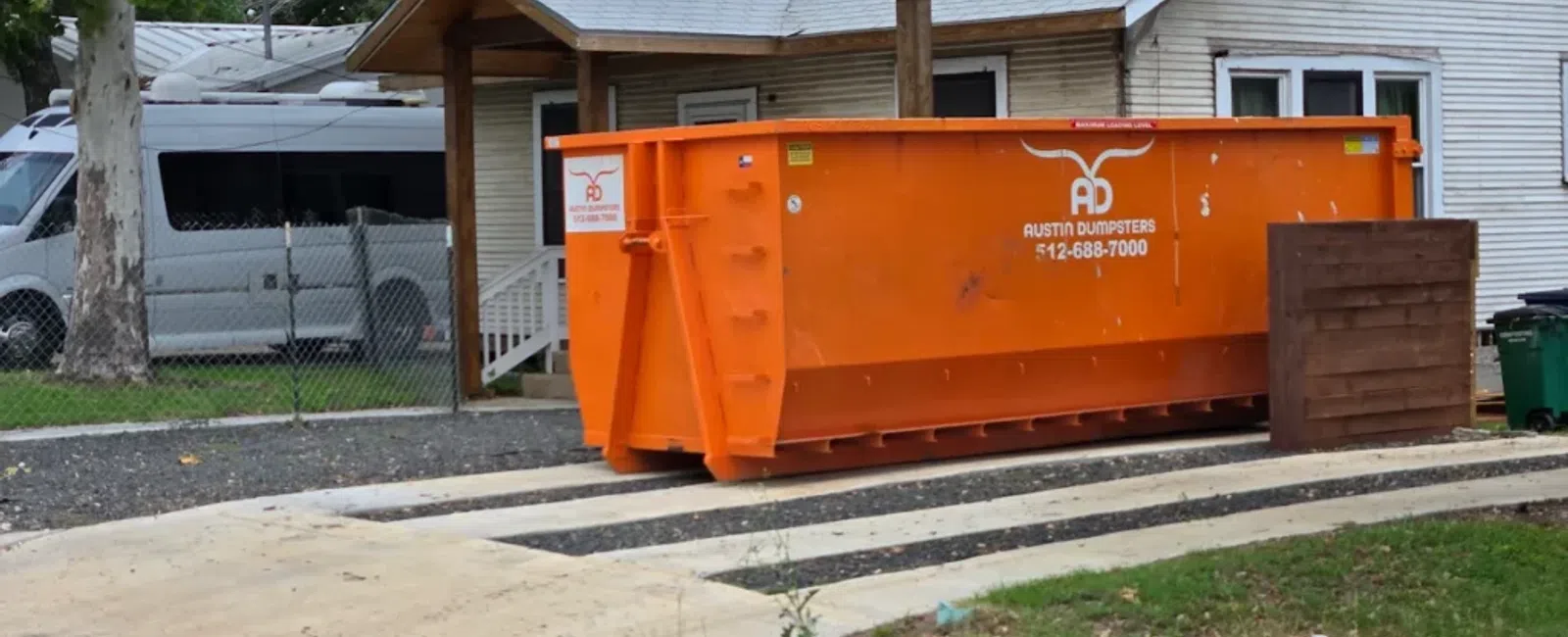
Most delivery problems have nothing to do with the container. They come down to the spot it was supposed to go. A roll-off arrives on a truck that has to back in, tilt a steel box off the bed, and roll it into position, and that takes more room than a parking space.
Start with the driveway
For residential rentals, the driveway is where most containers go. It is flat, already built to hold vehicle weight, on private property, and usually lined up straight with the street. The tradeoff is that it is out of use for the length of the rental, since a 20-yard container plus working room will block most residential driveways completely.
What matters isn't the container footprint, but the room the truck needs around it. As a working rule for a standard residential delivery, plan on:
- Roughly 60 feet of straight, clear space measured from the street
- About 10 to 12 feet of width, free of parked cars, mailboxes, and low retaining walls
- Overhead clearance well above the roofline, since the bed lifts much higher than the container is tall
Low branches, power and cable lines, carport overhangs, and basketball hoops all sit in that overhead path. If your spot is tight on any of it, say so when you book. Our delivery and pickup process covers what happens on the day itself.
The surface underneath is already covered
A loaded roll-off puts real weight on a few contact points, and it rolls into place rather than being set down gently. That is why our drivers put boards down on every drop and keep the container on them, including on pavers, stamped concrete, and sealed driveways. You do not need to stage plywood yourself.
Boards spread the load, but they don't change what's underneath. Older concrete with visible cracks, stained or decorative finishes, asphalt in the middle of a Central Texas summer, and anything running below grade like irrigation lines or septic components are all worth mentioning when you book.
Unpaved ground works too, and on land clearing or new construction it is often the only option. Gravel and compacted caliche hold up fine. Grass and bare dirt depend on recent rain, and soft ground can leave a loaded container tilted or partially sunk. Slope is the other thing to watch, since a noticeable grade puts the load off center and makes the swing door hard to control.
Street placement
If the container sits on your driveway or elsewhere on private property, you generally don't need a permit. Street and public right-of-way placement is the exception, and requirements vary across the cities we serve around Austin. On narrow lots, steep driveways, or properties with no driveway access, that may be the only realistic option. Tell us when you book, and we will help you sort it out before delivery day.
Point the door at the work
Once you know where the container can go, decide where you actually want it. You'll walk that distance hundreds of times over a rental, usually carrying something heavy. Worth settling before the truck leaves:
- Which way the swing door faces, since walking debris in is far easier than lifting it over a four-foot wall
- How close it sits to the exit you will be hauling from, whether that is a garage, side gate, or front door
- Whether the load path avoids sprinkler heads, valve boxes, and soft ground that will rut under a wheelbarrow
The driver can set the angle and door direction at drop, but only if it is spelled out first, either in your placement instructions or on site. Once the container is down and being loaded, moving it means bringing the truck back.
What to move before delivery day
Most things near a drop spot aren't a problem. A recycling bin or a stray bike takes a driver a few seconds to step aside. The only thing a driver cannot move is your vehicle, and a car parked in the approach is the most common reason a container ends up somewhere other than where you pictured it. Park elsewhere the night before, and handle anything that needs a key or code by unlocking the gate or leaving the code with us. You do not need to be home for the drop as long as we know where the container is going.
It also helps to know what is going in before it shows up, since some common household and jobsite materials cannot go in a roll-off at all. Our list of items not allowed in a dumpster covers those.
Footprint of a 10-yard versus a 20-yard
Size affects placement mostly through length. A 10-yard container fits tighter driveways, narrow lots, and approaches that are not perfectly straight. It suits small bath or kitchen demo, garage and closet cleanouts, and dense material like tile, brick, or concrete, where the container fills by weight long before volume.
A 20-yard is noticeably longer and needs a more generous approach, but it is the right call for whole room renovations, roof tear-offs, large decluttering jobs, and flooring removal across multiple rooms. Bulky, light debris eats volume fast. Our breakdown on choosing the right roll-off size goes deeper, and the piece on why weight fills a dumpster before volume does explains when the smaller container is the better fit.
Not sure your spot will work?
Describe your driveway, the branch you are worried about, or the slope you are unsure about, and we will tell you what fits. Call Austin Dumpsters at (512) 688-7000, and we will help you pick a size and a placement that works the first time.